
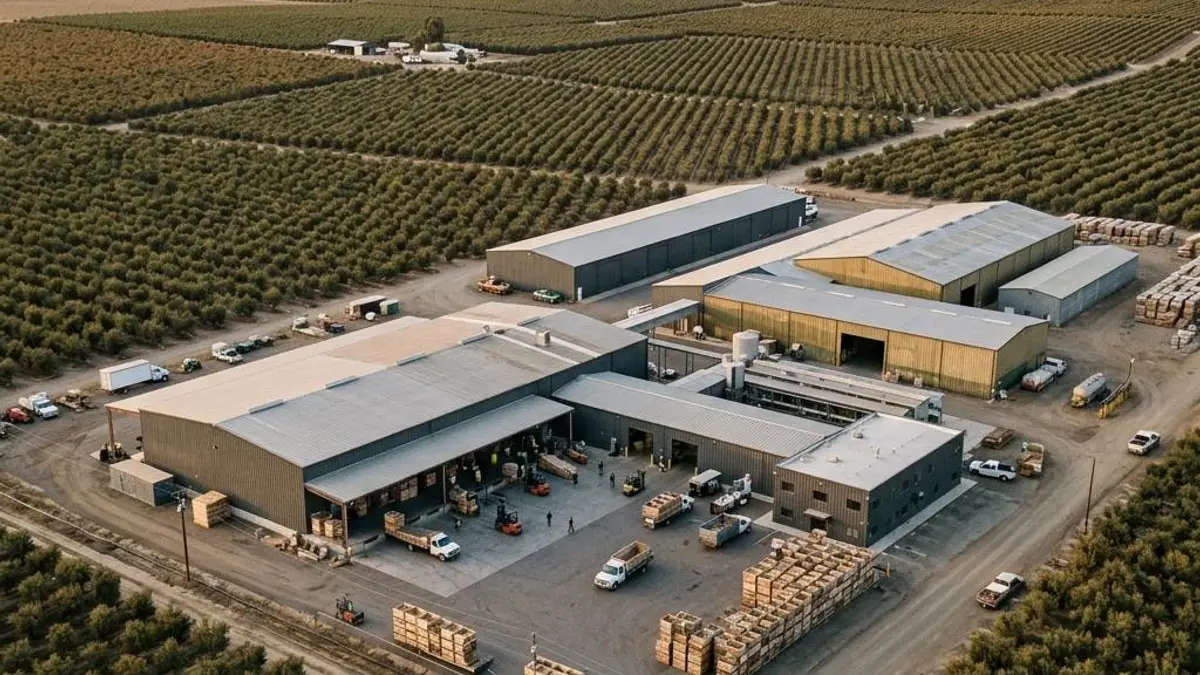
Food Processing
Seasonal raw product, year-round plant economics.
Food processors manage commodity inputs, capital-intensive plants, and powerful retail customers.
How capital moves from raw commodity to finished product
Input cost pass-through
Margin depends on how quickly commodity costs reach customer prices.
Read more: Input cost pass-through
Food processors buy agricultural commodities and packaging, convert them, and sell to retailers, foodservice distributors, or other manufacturers. Raw material can be a large share of cost, while customer pricing is often set by contract or negotiated periodically. When input costs rise faster than prices can be adjusted, margins compress. Contract terms, hedging, and the speed of price renegotiation determine how much volatility the processor absorbs.
Perishability, inventory, and yield
Product life and conversion yield shape working capital and margin.
Read more: Perishability, inventory, and yield
Perishable inputs must be processed quickly, while finished goods may be frozen, shelf-stable, or short-dated. Inventory levels, spoilage, and conversion yields directly affect margin. Seasonal crops may require buying and processing a year's supply in a few months, creating large inventory peaks financed through working-capital lines. Accurate yield and inventory costing is essential for understanding true product profitability.
Capacity, utilization, and capital investment
Plants earn returns when volume fills capacity efficiently.
Read more: Capacity, utilization, and capital investment
Processing facilities carry substantial fixed costs for equipment, food safety systems, and labor. Utilization, line speed, changeover time, and downtime determine unit cost. Capital investment in automation, capacity, or new product lines must be justified against realistic volume commitments. Underutilized plants can generate losses even with strong demand elsewhere in the portfolio.
Customer concentration and trade terms
Large retail and foodservice customers set demanding terms.
Read more: Customer concentration and trade terms
Many processors depend on a few large customers whose purchasing practices include slotting fees, promotional allowances, chargebacks, and extended payment terms. These deductions can significantly reduce net revenue if not tracked carefully. Private-label contracts offer volume but often narrow margins. Understanding net profitability by customer and product after all trade spending is essential to pricing and growth decisions.
Where food processors feel financial pressure
Commodity cost volatility
Rapid input cost swings outpace pricing adjustments.
Read more: Commodity cost volatility
Price increases on key ingredients, packaging, or energy can compress margins before customer contracts reset. Hedging and forward purchasing help but carry costs and commitments. Visibility into exposure by product and customer supports faster, better-informed pricing conversations.
Trade spend and deductions
Customer deductions erode net revenue when unmanaged.
Read more: Trade spend and deductions
Promotional allowances, chargebacks, and unauthorized deductions can accumulate quickly. Without systematic tracking and dispute processes, net revenue is overstated and cash is lost. Analysis by customer reveals where trade terms are worth renegotiating.
Product costing accuracy
Inaccurate costing hides unprofitable products.
Read more: Product costing accuracy
Yield loss, changeover time, and overhead allocation affect true product cost. Standard costs that are not updated can make unprofitable products look acceptable. Accurate costing supports better pricing, portfolio decisions, and customer negotiations.
Seasonal inventory financing
Pack seasons create large working-capital peaks.
Read more: Seasonal inventory financing
Processors of seasonal crops build large inventories over short periods and sell them across the year. Borrowing needs peak quickly, and inventory valuation affects borrowing-base availability. Monthly cash forecasting and realistic sales assumptions are essential.
Labor availability and cost
Plant staffing shortages affect throughput and cost.
Read more: Labor availability and cost
Many plants struggle to recruit and retain workers, leading to overtime, reduced shifts, or higher wages. Automation can help but requires capital. Labor cost per unit should be monitored alongside throughput and quality. Turnover and training costs also deserve attention, since they affect quality and yield.
Food safety and recall exposure
Quality events carry large financial consequences.
Read more: Food safety and recall exposure
Recalls, quality failures, or regulatory findings can result in lost product, customer chargebacks, and reputational damage. Food safety compliance is a matter for qualified specialists, but financial plans should account for the cost of compliance and the liquidity impact of a potential event.
Advisory for processors balancing commodity cost and customer pricing
Capital Structure & Financing
Working-capital lines, equipment financing, and refinancing as borrower.
Read more: Capital Structure & Financing
Perrin & Co. analyzes seasonal working-capital needs, borrowing-base structures, equipment and facility financing, and refinancing alternatives, and supports processors in lender discussions as borrower. Terms vary by lender and facility. The firm acts for the processor, not the lender, and analysis is tested against realistic seasonal peaks and price scenarios.
Finance & Accounting Advisory
Product costing, trade spend tracking, and close.
Read more: Finance & Accounting Advisory
Work can include standard cost and yield analysis, trade spend and deduction tracking, inventory costing, and close processes. Interim or fractional CFO leadership is available for processors that need senior finance capacity during growth or transition. Reporting is designed for lender and customer review.
Business Advisory
Customer and product profitability and capacity decisions.
Read more: Business Advisory
Financial decision support analyzes net profitability by customer and product after trade spend, evaluates capacity and automation investments, and informs pricing strategy. The aim is a product and customer portfolio that produces reliable margin and cash. Recommendations are tested against downside cases.
Technology Solutions
Connecting production, inventory, and accounting data.
Read more: Technology Solutions
Perrin & Co.'s Technology Solutions capability can help integrate production, inventory, and accounting systems so yield, cost, and deduction data are available promptly and reconcile to the ledger, reducing manual reporting effort. Better data also supports faster customer pricing discussions when costs change.
Where to start
- Business AdvisoryProfitability and capital project decisions.
- Capital StructureInventory and capex financing.
- Finance & Accounting AdvisoryCost accounting and reporting.
Scope qualification. Perrin & Co. does not provide food-safety, regulatory, or quality-assurance services. Engagements address financial and operational matters.
More in Agriculture & Agribusiness
Related perspective
Discuss your food processing priorities
A confidential conversation with Perrin & Co. — no obligation, and a candid view of whether we can help.