
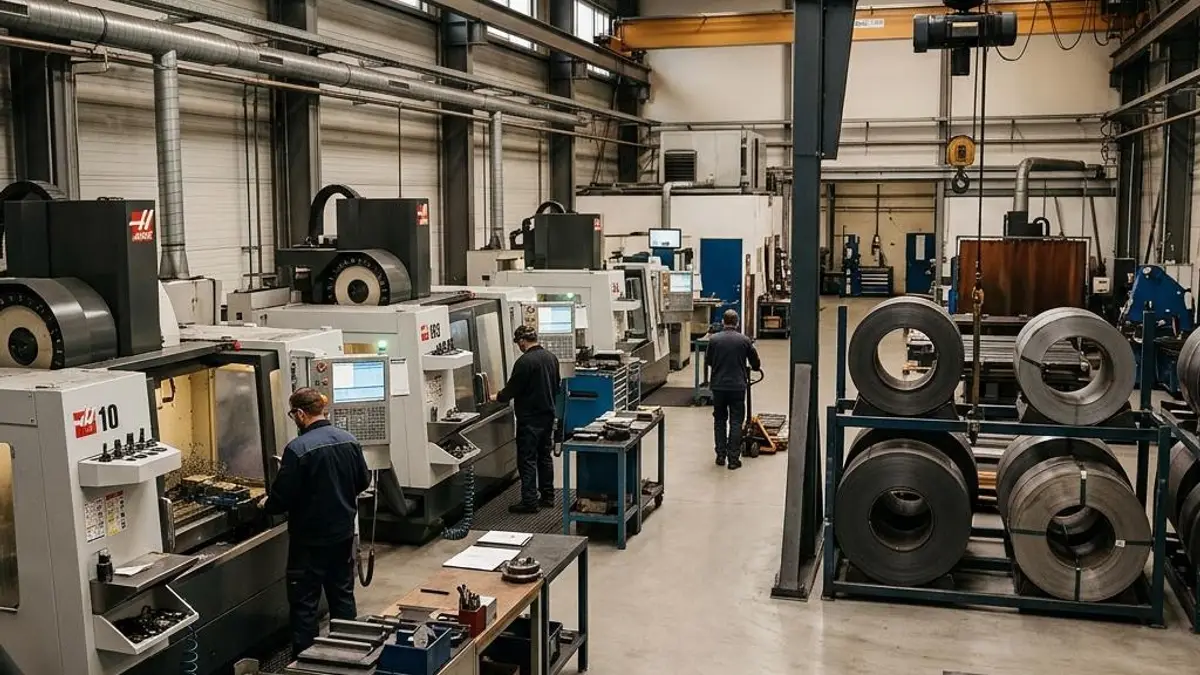
Advanced Manufacturing
Automation changes the cost structure — and the capital plan.
Precision and automated manufacturers trade labor cost for capital intensity and technical risk.
How capital moves through advanced manufacturing
Technology investment and capital intensity
Precision equipment and automation demand heavy upfront capital.
Read more: Technology investment and capital intensity
Advanced manufacturers in aerospace, medical device components, semiconductors, robotics, and additive manufacturing rely on expensive precision equipment, clean rooms, and automation. Capital requirements are high relative to revenue, and equipment can become obsolete as technology advances. Return on investment depends on achieving utilization quickly. Equipment financing and leasing choices therefore shape both the balance sheet and the pace of growth.
Qualification, certification, and long sales cycles
Customers require extensive qualification before buying in volume.
Read more: Qualification, certification, and long sales cycles
Aerospace, defense, and medical customers require certifications, process validation, and first-article approval before production orders. Qualification can take months or years and consumes engineering resources without revenue. Once qualified, relationships can be durable, but the upfront investment must be financed. Revenue forecasts must reflect qualification timelines realistically rather than assuming immediate volume. Qualification costs should be tracked by customer program so management can compare them with expected returns.
Low-volume, high-mix economics
Many small orders with complex specifications complicate costing.
Read more: Low-volume, high-mix economics
Advanced manufacturers often produce many part numbers in small quantities with demanding tolerances. Setup time, inspection, scrap, and engineering support represent a large share of cost. Traditional costing methods may misallocate overhead, making some products appear profitable when they are not. Activity-based analysis of setup, inspection, and engineering effort improves pricing accuracy. Engineering effort for difficult parts is often underpriced as a result of these averaging methods.
Growth financing and investor expectations
Rapid growth requires capital ahead of revenue.
Read more: Growth financing and investor expectations
Companies scaling new technologies may combine venture or private equity investment with equipment financing, government incentives, and customer-funded development. Each source carries different expectations and reporting requirements. Growth often requires capacity investment ahead of confirmed orders. Matching capital sources to the risk and timing of each investment avoids liquidity strain during scale-up. Customer-funded development may limit intellectual property rights, which should be considered alongside its cost.
Where advanced manufacturers feel pressure
Qualification delays
Longer-than-expected approvals push out revenue.
Read more: Qualification delays
Certification and customer qualification often take longer than planned, delaying production revenue while engineering and capacity costs continue. Forecasts should include realistic qualification timelines and contingency for delays, so that runway and borrowing capacity are sufficient to reach volume production.
Costing complex products
Setup and inspection costs are easily misallocated.
Read more: Costing complex products
Low-volume, high-mix production makes accurate costing difficult. Inspection, setup, and engineering time may be spread evenly across products when they are concentrated in a few. Better cost allocation improves pricing and identifies products or customers that consume disproportionate resources. Pricing can then reflect true cost.
Technology obsolescence
Rapidly advancing technology shortens equipment useful life.
Read more: Technology obsolescence
Equipment purchased today may be surpassed within a few years. Depreciation assumptions, financing terms, and replacement plans must reflect realistic technology life. Leasing may provide flexibility but at higher cost. Investment decisions should weigh these tradeoffs explicitly. Residual values should be estimated conservatively.
Specialized talent
Engineers and technicians with specialized skills are scarce.
Read more: Specialized talent
Advanced manufacturing depends on engineers, programmers, and technicians with rare skills. Recruiting costs and wage pressure are significant. Talent constraints can limit growth even when demand exists. Workforce planning should be integrated with capacity and financial planning.
Quality cost and compliance
Scrap, rework, and traceability requirements add cost.
Read more: Quality cost and compliance
Tight tolerances and regulatory requirements increase scrap and rework costs and require detailed traceability. Quality failures can lead to customer penalties or lost qualification. Tracking cost of quality alongside production metrics supports improvement and pricing decisions. Quality data also supports customer negotiations.
Scale-up liquidity
Capacity investment ahead of orders strains cash.
Read more: Scale-up liquidity
Building capacity before orders are confirmed requires capital that may not be recovered quickly if demand develops slowly. Staging investment against customer commitments and maintaining liquidity buffers reduces risk during scale-up. Contingency plans for slower demand should be prepared before major commitments are made, not after.
Advisory for precision, automation, and high-specification production
Capital Structure & Financing
Equipment finance, growth capital, and lender strategy as borrower.
Read more: Capital Structure & Financing
Perrin & Co. analyzes equipment financing and leasing alternatives, debt capacity, and the interaction of investor capital, incentives, and customer funding, and supports management in lender discussions as borrower. The firm does not place securities or raise equity. Terms vary by facility.
Finance & Accounting Advisory
Activity-based costing, quality cost tracking, and close.
Read more: Finance & Accounting Advisory
Work can include activity-based cost analysis for setup, inspection, and engineering, cost-of-quality reporting, grant and incentive compliance tracking, and close processes. Interim or fractional CFO leadership is available during scale-up or ahead of financing rounds. Reporting is designed for investor and lender review.
Business Advisory
Pricing, capacity staging, and customer profitability.
Read more: Business Advisory
Financial decision support evaluates pricing accuracy, capacity investment staged against customer commitments, and customer and product profitability. Analysis helps leadership decide which markets and qualifications to pursue given available capital and talent. Recommendations are tested against realistic qualification timelines and capital constraints.
Technology Solutions
Integrating production, quality, and financial data.
Read more: Technology Solutions
Perrin & Co.'s Technology Solutions capability can help integrate production, quality, and accounting systems so cost, scrap, and traceability data are timely and consistent, improving costing accuracy and reducing manual reporting effort. Better data also supports qualification documentation and audit readiness.
Where to start
- Business AdvisoryInvestment and growth decisions.
- Finance & Accounting AdvisoryCost reporting and planning.
Scope qualification. Perrin & Co. does not provide export-control, defense-contracting compliance, or engineering services. Engagements address finance and operations.
More in Manufacturing & Industrials
Discuss your advanced manufacturing priorities
A confidential conversation with Perrin & Co. — no obligation, and a candid view of whether we can help.